
Why 55% of Mid-Market Companies Miss Their Revenue Forecasts (And How to Fix It)

Your revenue forecast said you'd close $2.3M this quarter. You closed $1.8M. Your leadership team is frustrated. Your board is asking questions. Your sales team is defensive.
You're not alone. According to RevOps leaders discussing their 2026 planning, 55% of mid-market B2B companies miss their quarterly revenue forecasts by more than 10%.1
But here's what's important to understand: your team isn't missing the forecast because they're not trying hard enough. They're missing it because the operational foundation supporting that forecast is broken.
The Forecast Isn't the Problem. The Foundation Is.
Most revenue leaders treat forecast accuracy as a sales execution issue. They assume better coaching, more activity, or tighter pipeline reviews will fix it.
Those things help. But they're not the root cause.
The real issue lives in the operational gaps that compound throughout the quarter. Messy data. Undefined processes. Broken hand-offs. Misaligned definitions. These invisible problems distort visibility so badly that by the time you realize the forecast is off, it's too late to fix it.
Think about how a forecast actually gets built: A sales rep enters a deal into your CRM. That deal moves through stages based on criteria that might not be clearly defined. Along the way, data quality deteriorates. Information gets lost in hand-offs between teams. By the time leadership reviews the pipeline, the visibility is compromised.
If you build a forecast on that foundation, the forecast will be wrong.
The Three Operational Gaps That Kill Forecast Accuracy
Gap 1: Data Quality Deterioration
Your CRM is supposed to be your single source of truth. In reality, most mid-market organizations operate with significant data quality issues that go unaddressed until forecast time.
Duplicate records hide true account penetration. Incomplete contact fields mean follow-up gets missed. Missing personas mean you don't know who you should be talking to at the account. Inconsistent field naming creates confusion. Deal records lack required information. Over time, these small issues compound into a dataset that can't support accurate forecasting.
A study on CRM data quality found that the average organization has duplicate rates of 20 to 30%.2 That's not a data hygiene problem. That's a visibility problem. If 20 to 30% of your account data is duplicated, your pipeline counts are inflated. Your forecast is built on fiction.
But there's another data problem that's less obvious: contact and persona gaps. You might have 50 accounts in your pipeline, but do you have visibility into all the decision-makers at those accounts? Are you missing key personas that would accelerate deals? Most mid-market organizations have blind spots in their buying group coverage. You're only seeing part of the picture.
The worst part? Most teams don't realize how bad it is until they actually audit their data. By then, you're in the middle of forecasting season.
Gap 2: Process Ambiguity
Your sales process probably has stages: Lead, Qualified Lead, Opportunity, Negotiation, Closed Won. But does everyone on your team interpret "Opportunity" the same way? What's the entry criteria? What has to happen before a deal moves to "Negotiation"?
Most mid-market organizations don't have documented answers to these questions. Instead, each sales rep has their own interpretation. One rep moves deals to Opportunity after a discovery call. Another waits until budget is confirmed. A third moves deals when they've talked to the decision maker.
Now your pipeline report shows 15 opportunities. But those opportunities are actually at different stages of maturity. Your forecast assumes they'll all progress at the same rate. They won't.
But there's a deeper issue: you're probably prioritizing deals based on where they are in your process, not based on actual buying signals. In reality, some deals in early stages have strong intent signals. Others in late stages are stalled. If you're forecasting based on process stage alone instead of actual buying behavior, you're missing the signal that tells you which deals will actually close.
According to research on RevOps maturity, organizations without clearly defined pipeline stages and entry/exit criteria consistently struggle with forecast accuracy and pipeline visibility.3 Add signal-based prioritization to that definition, and you unlock better forecasting because you're seeing which deals are actually moving.
Gap 3: The Hand-Off Problem
Most mid-market organizations have three critical hand-offs: Marketing to Sales, Sales to Customer Success, and Customer Success back to Sales (for expansion). Each of these hand-offs is supposed to transfer information and ownership.
In practice, they transfer incomplete information and unclear ownership.
Marketing hands off a lead to Sales without clarity on what constitutes an SQL. Sales hands off a new customer to CS without documented onboarding expectations. CS identifies expansion opportunities but doesn't know who to hand them back to or in what format.
Information gets lost. Context disappears. Timing gets missed. And when it's time to forecast, Sales doesn't have visibility into all the pipeline because some of it got stuck in hand-offs.
But there's another hand-off problem that's becoming more critical: visibility into how your messaging and content actually appears in AI-driven discovery. Your prospects are using AI tools to research solutions. They're asking AI engines questions about your company, your competitors, your positioning. But most RevOps teams have zero visibility into how they show up in those discovery moments. You don't know if your messaging is being cited. You don't know if you're losing share of voice to competitors in AI-driven conversations. That's a blind spot in your pipeline that impacts forecast accuracy.
Research on cross-functional alignment shows that organizations without explicitly defined hand-offs and SLAs between Marketing, Sales, and Customer Success experience significant revenue leakage.4 Deals don't progress smoothly. Forecasts don't match reality.
Why This Matters More in 2026
The pressure on forecast accuracy has intensified. Headcount budgets are flat but productivity expectations are rising. Leaders are being asked to do more with the same people. That means every deal matters. Every percentage point of forecast accuracy matters.
When you're operating with a 10 to 15% forecast miss, you're not just missing a number. You're creating chaos downstream. You're making hiring decisions based on false pipeline. You're committing resources to things that won't close. You're frustrating your team because they can't see a clear path to success.
The organizations winning in 2026 are the ones with operational clarity. Clean data. Complete contact and persona coverage. Defined processes grounded in buying signals. Clear hand-offs. And visibility into how they're showing up in AI-driven discovery. Those teams forecast accurately. They execute consistently. They scale without chaos.
The Audit That Changes Everything
You don't need a complete RevOps overhaul to fix forecast accuracy. You need visibility into where your forecast breaks down.
Start here:
1. Trace a Recent Forecast Miss
Pick a quarter where you missed forecast by a significant amount. Map where the miss originated. Was it a specific stage that didn't progress as expected? A particular deal size? A specific segment? A specific team?
The miss usually isn't random. It's concentrated. Find the concentration.
2. Audit Your Data Quality at That Bottleneck
If your miss came from deals stuck in Negotiation, audit your Negotiation stage deals. How many have complete information? How many have duplicates? How many have missing required fields? How many have gaps in buying group coverage?
You'll probably find 20 to 30% of records are incomplete or duplicated. That's your data quality problem. And you'll probably find you're missing key personas at your target accounts.
3. Document Your Actual Process
Ask your sales team how they actually move deals through stages. Don't ask how the process is supposed to work. Ask what actually happens.
You'll probably find that your documented process and your actual process don't match. Each person has workarounds. Each person has their own interpretation of what "Opportunity" means. And you'll probably find they're prioritizing based on process stage, not on actual buying signals.
Document what's actually happening. That's your baseline.
4. Map Your Hand-Offs and Visibility Gaps
Trace the information flow from Marketing to Sales to Customer Success. Where does information get lost? Where are there unclear SLAs? Where is ownership ambiguous? And critically, where do you have blind spots in how you're showing up in AI-driven discovery?
You'll probably find at least two hand-offs that are creating blind spots. You'll also probably find you have no visibility into how your messaging and content appears when prospects use AI to research solutions.
5. Identify Your Highest-Impact Fix
You can't fix everything at once. But you can fix the one thing that's distorting your forecast the most. Is it data quality in a specific stage? Is it process ambiguity in how deals move? Is it a hand-off that's breaking? Is it missing visibility into buying group coverage or how you're showing up in AI-driven discovery?
Fix that first. Everything else follows.
The Real Insight
Your forecast accuracy isn't a sales problem. It's an operational problem. And operational problems have operational solutions.
You don't need better salespeople. You don't need more activity. You don't need more aggressive coaching.
You need clarity. You need clean data with complete buying group coverage. You need defined processes grounded in actual buying signals. You need clear hand-offs. And you need visibility into how you're actually being discovered and discussed in AI-driven conversations.
Fix those, and your forecast gets better. Your team executes more effectively. Your leadership has visibility. Your board gets accurate numbers.
The 55% of mid-market companies missing forecast are operating with operational gaps they haven't fixed. The 45% that hit forecast? They've fixed those gaps.
Which group do you want to be in?
References
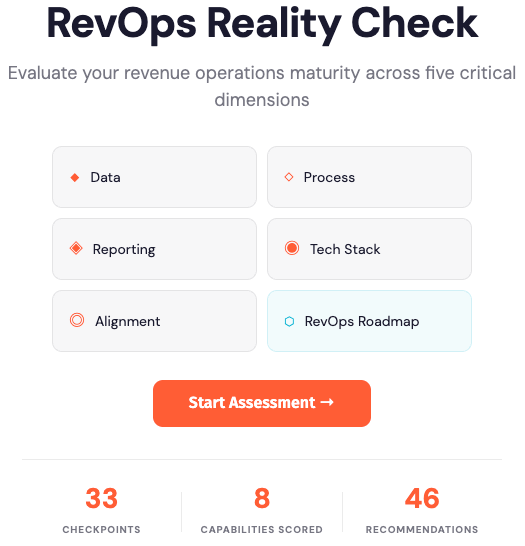
Check out our RevOps Reality Check! It grades your company's RevOps maturity across 5 critical frameworks. Click here to fill yours out!
Featured Content