By moving away from costly external agencies, a leading dealership group took absolute control of its customer data and digital marketing footprint.
Through a sophisticated integration of HubSpot, CDK Drive DMS, eLeads CRM, and Salesmsg, 1406 Consulting helped this forward-thinking dealership group build an in-house engine that unifies fragmented dealership data, reduces duplicate records, and turns live vehicle inventory and customer transaction histories into a continuous stream of actionable sales and service opportunities.
Overview
A leading dealership group operates a multi-location automotive business across 9 rooftops, including three key Nissan locations in Dalton, Chattanooga, and Cleveland.
Their team set out to disrupt the traditional dealership space by adopting cutting-edge marketing technology.
For years, the business relied on an external digital agency to drive traffic and execute their digital campaigns.
However, leadership wanted digital sovereignty; they wanted to bring their marketing in-house, capture first-party data, and replace the slow-moving agency model with highly automated, personalized consumer journeys.
To make this transition profitable and scalable, they partnered with 1406 Consulting to build a unified, trustworthy view of customer and dealership activity across sales, service, and marketing functions.
Challenge
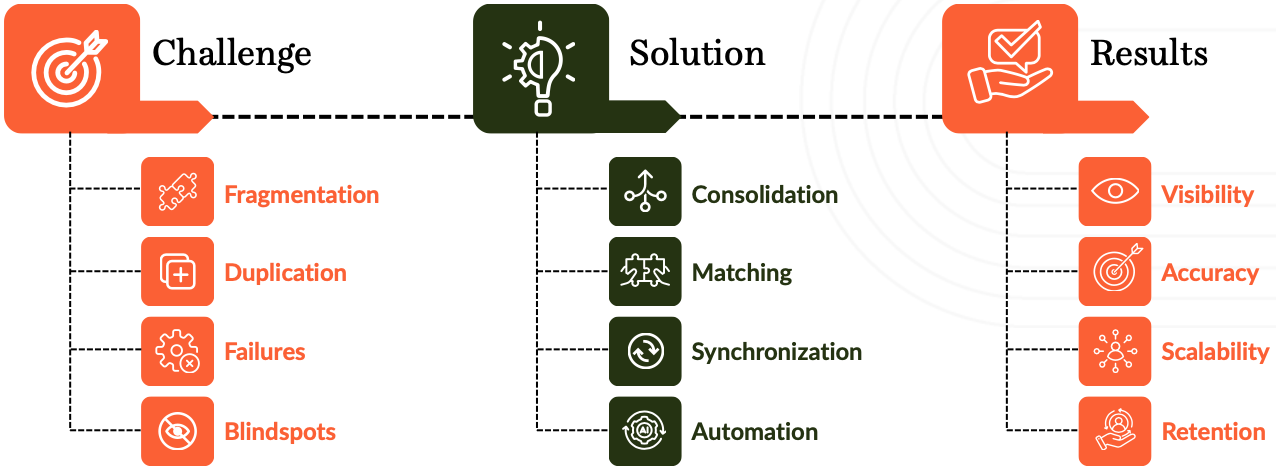
The path to digital self-sufficiency was blocked by legacy automotive data structures. HubSpot is a platform natively built for B2B relationship management, but automotive marketing is a fast-paced, transactional D2C environment.
Disconnected Data Sources
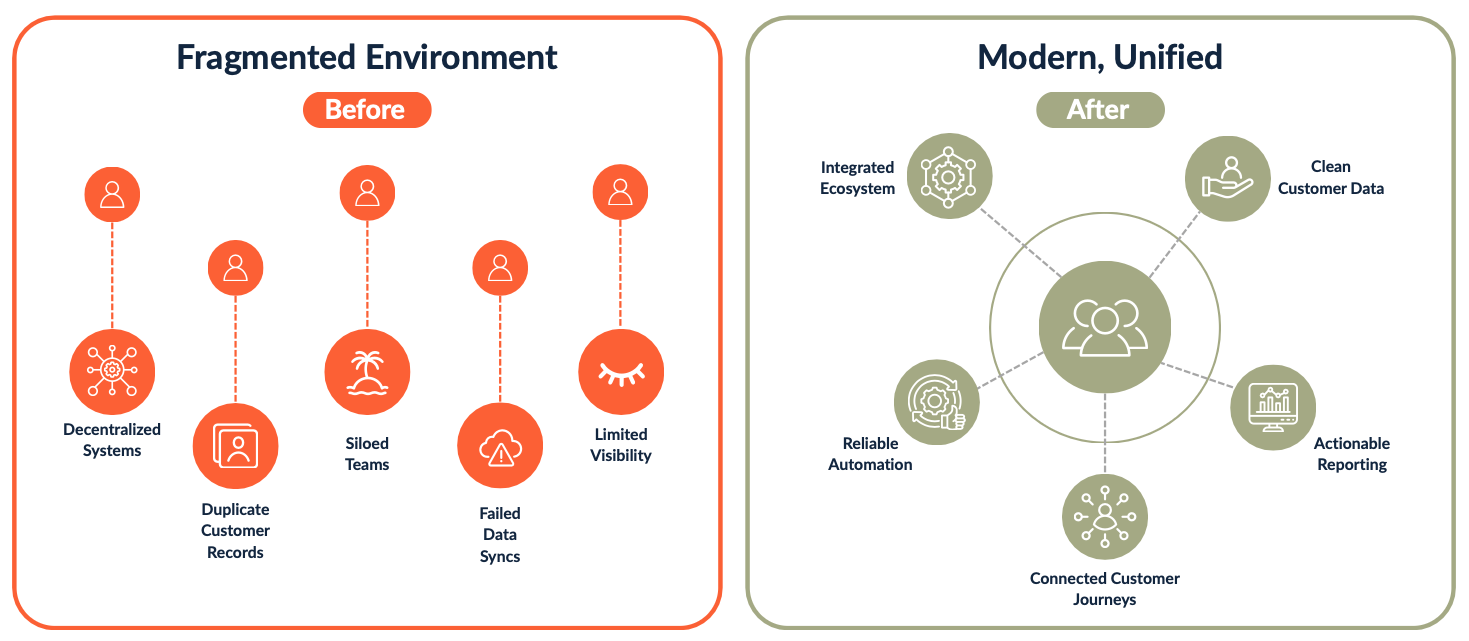
Customer and transaction data existed across CDK, Fortellis, eLeads, and HomeNet. Each source introduced its own unique data structure, update behavior, and limitations.
Sales records, repair orders, parts sales, opportunities, and vehicle-related data were completely siloed, preventing a clear view of the customer journey inside HubSpot.
Server Sync Failures
Early sync attempts ran into technical roadblocks. The massive amount of historical sales and service data was too heavy for on-demand cloud servers, causing the sync process to time out and drop data silently mid-sync.
This severely damaged organizational trust in the implementation.
Extreme Database Duplication
One of the most severe issues was duplicate contact creation. The source systems relied on identifiers like CDK or Fortellis customer IDs rather than email addresses as the unique matching key.
In a multi-rooftop environment, this created multiple records for the same person (up to five separate records for a single customer across locations), fragmenting engagement history, sales records, and service activity.
Showroom Disconnects
Floor salespeople operated blindly inside eLeads CRM, while the marketing team had no reliable way to see who had actually bought a car or had a recent service appointment.
Without a unified database, marketing campaigns risked targeting recent buyers, creating a disjointed customer experience and risking critical contract renewals.
The Solution
To clear these roadblocks, the technical team at 1406 Consulting engineered a custom, robust data architecture designed specifically for the automotive retail workflow. The work evolved across three major areas:
Integration Architecture
We migrated the data sync pipeline to a persistent server type, completely eliminating on-demand virtual server timeouts and establishing a rock-solid, nightly data sync of F&I sales, repair orders, and parts sales.
We mapped these raw transactions into separate, structured HubSpot deal pipelines (F&I Sales, Repair Orders, Parts Sales, and CRM Opportunities) and supported line-item creation from fees and related financial values.
The website component supported this infrastructure. Standardized templates for location pages, the homepage, and the careers portal ensured a cohesive digital experience, while the broader integration of dealership data fueled live vehicle inventory page considerations.
Data Quality Remediation
The team refactored the integration logic, establishing email as the default primary identifier for contact records.
A custom merge script normalized incoming records via the Fortellis Email field, consolidating hundreds of thousands of duplicate records into clean, unified customer profiles.
This de-duplication logic maintained distinct transactional history while ensuring that any new data automatically appended to the correct, single contact. The team also addressed mismatched associations, such as cases where the wrong contact was attached to a sale.
Operational Reporting and Segmentation
To turn HubSpot into an active operating system, we built backend workflows that calculated and populated Last Sale Date (using contract dates) and Last Service Date (using repair order posted dates) directly on the contact record during deal creation.
This allowed their leadership to filter the database by purchase and service recency without dragging down system performance.
We also mapped the live HomeNet vehicle feed directly into HubSpot's native Products object table. This made over 20,000 active, VIN-level vehicle listings immediately available as dynamic content blocks for highly personalized marketing emails and exit-intent price drop pop-ups.
By installing Salesmsg, 1406 enabled automated SMS and Ringless Voicemail (RVM) campaigns. High-intent website visitors who browsed specific vehicle categories were dropped into targeted SMS re-engagement sequences.
To bridge the gap back to the showroom floor, we designed an ADF XML lead bridge. When an automated price-drop alert or RVM campaign engaged a cold prospect, HubSpot automatically generated a structured lead task inside eLeads CRM, alerting a physical salesperson to make a timely, coordinated phone call.
The Results
By redesigning their integration and data management approach, 1406 delivered a more usable HubSpot environment that transformed the platform from a fragmented repository into an operational system supporting real outreach and decision-making.
The engagement unified complex dealership data from multiple sources (CDK, Fortellis, and eLeads) into a cohesive HubSpot structure. Through redesigned record matching logic, the team eliminated duplicate contact issues that had fragmented customer history.
Data quality improvements across contact, deal, and branch-level records created a foundation the client could trust for segmentation, reporting, and campaign execution.
More importantly, the work enabled the client to operationalize key business use cases:
-
Service and sales segmentation through operational fields like last sale date and last service date.
-
Actionable store-level customer lists for targeted outreach and follow-up
-
Service reactivation workflows identifying customers who hadn't serviced in over a year
-
An ongoing reconciliation process that improved reliability and reduced data drift over time
The result was a CRM that could reliably answer critical business questions (who bought, who serviced, who had lapsed, and which rooftop they belonged to) and support meaningful customer outreach across a multi-location operation.
Ready to Transform Your HubSpot Environment?
If your dealership is struggling with fragmented data, duplicate records, or unreliable reporting, 1406 Consulting can help.
We specialize in turning complex automotive integrations into operational systems that drive real business results. Click the button below to schedule a call.